
DIY vs Hiring a SOC 2 Consultant: When It Actually Makes Sense

Updated: Apr 7
Executive Summary
If you’re deciding whether to DIY SOC 2 or hire a consultant, the answer depends on four structural factors:
Time availability – Can you dedicate 20+ hours per week consistently?
Audit experience – Have you successfully completed SOC 2 before?
Complexity – Are you pursuing Type II, handling regulated data, or serving enterprise customers?
Revenue pressure – Do deals or fundraising depend on compliance timing?
DIY can work in low-complexity, low-pressure environments.
But once enterprise sales, regulated data, or tight timelines enter the picture, mis-sequencing SOC 2 is more expensive than advisory support.
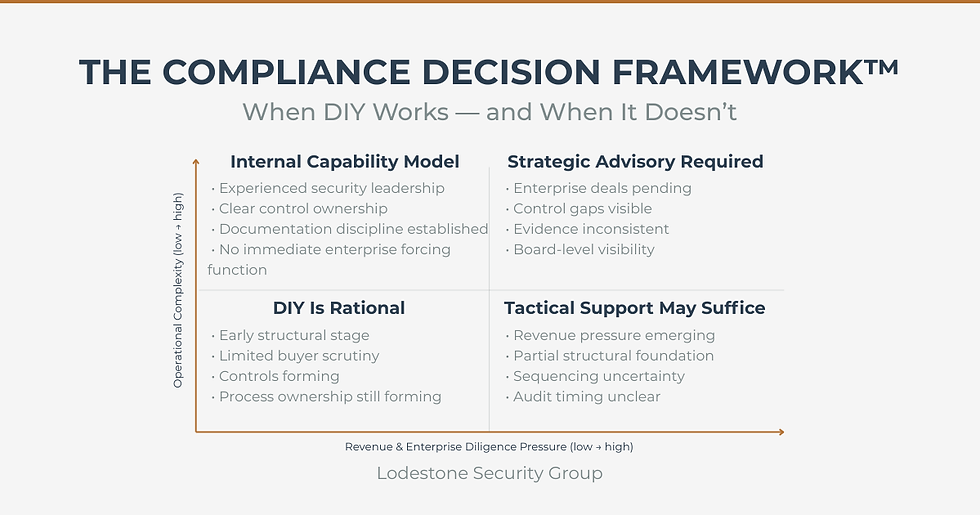
If you want a structured assessment of where you fall, start with the Compliance Decision Framework™.
The Illusion of “Simple” Compliance
SOC 2 looks procedural:
Write policies
Implement controls
Collect evidence
Pass audit
In practice, it’s structural.
Policies must reflect actual operations. Controls must be consistently executed. Evidence must demonstrate repeatability. Documentation must withstand auditor scrutiny.
When those layers misalign, the result isn’t a small correction. It’s rework.
And rework delays revenue.
The Real Cost of DIY SOC 2
Most founders underestimate three variables.
Time
SOC 2 Type II typically requires 800–1,600 hours across:
Policy alignment
Control implementation
Evidence collection
Observation period maintenance
Audit coordination
That is not a side initiative. It is operational infrastructure.
Rework
Common DIY failure points:
Mis-scoped audit boundaries
Starting the observation period prematurely
Controls implemented but not documented
Evidence that doesn’t prove consistency
Each adds delay and increases audit risk.
Opportunity Cost
Time spent reverse-engineering compliance is time not spent:
Closing enterprise deals
Building product
Raising capital
Compliance is not free just because consultant fees are absent.
When DIY SOC 2 Makes Sense
DIY is viable when:
You’re pre-seed or early seed
You’re pursuing SOC 2 Type I only
Your architecture is simple
You have internal audit or security expertise
No enterprise revenue depends on audit timing
Timeline flexibility exists
In low-complexity environments, DIY can be efficient.
When Hiring a SOC 2 Consultant Is Necessary
Advisory support becomes structurally important when:
You’re pursuing SOC 2 Type II
Enterprise deals require audit validation
You handle regulated or highly sensitive data
You lack prior audit execution experience
You must complete within 6–12 months
You are at or beyond Series A
At this stage, compliance is revenue infrastructure — not documentation.
Infrastructure built incorrectly creates compound risk.
What a Consultant Changes
A strong consultant does not “do compliance for you.”
They:
Define scope correctly
Sequence work logically
Prevent observation-period timing errors
Align policies with operational reality
Ensure evidence supports audit defensibility
The value is not templates.
It is sequencing discipline.
The Hybrid Model
Many companies stage their approach:
Project-based support for audit preparation
Fractional leadership during observation
Internal ownership post-certification
This balances cost control with structural clarity.
It also aligns with companies scaling through Series A–B.
The Decision Is Structural, Not Financial
The wrong question is:
“Can we afford a consultant?”
The right question is:
“Can we afford to mis-sequence this?”
If complexity and revenue pressure are low, DIY can work.
If enterprise sales, regulatory exposure, or timeline sensitivity exist, advisory support reduces risk and accelerates defensibility.
Final Takeaway
DIY SOC 2 is cheaper upfront.
But once compliance affects revenue, fundraising, or customer trust, it becomes architecture.
And architecture requires precision.
If you’re unsure where you sit, start with the Compliance Decision Framework™. It evaluates revenue pressure, operational stability, risk surface, and ownership — the dimensions that determine whether DIY makes sense for your stage.
Want more structural insights and trust architecture resources? Join the Lodestone mailing list for updates.

Comments