
SOC 2 vs ISO 27001: Which Should You Do First — and Why It Depends on Revenue Pressure

Updated: Apr 7
Executive Summary
Choosing between SOC 2 and ISO 27001 is not about which framework is “better.” It’s about which trust signal your market expects first.
SOC 2 is typically prioritized by U.S.-based SaaS companies selling into enterprise procurement environments. It validates control effectiveness over time.
ISO 27001 is internationally recognized and signals structured governance through a formal Information Security Management System (ISMS).
For most Series A–B SaaS companies targeting U.S. enterprise customers, SOC 2 is the faster commercial signal.
For globally expanding or Europe-focused companies, ISO 27001 may be strategically prioritized.
The correct sequencing depends on revenue pressure, geographic exposure, and operational maturity — not preference.
Founders often ask:
“Should we do SOC 2 or ISO 27001 first?”
The wrong answer is a checklist comparison.
The right answer depends on:
Your target customers
Your geographic exposure
Your revenue pressure
Your operational maturity
SOC 2 and ISO 27001 are not interchangeable.
They send different trust signals to different markets.
What SOC 2 Signals
SOC 2 is most common in:
U.S.-based SaaS companies
Enterprise procurement environments
Mid-market and enterprise sales
It evaluates whether your controls:
Exist
Operate consistently
Produce evidence over time
SOC 2 is not a certification. It’s an attestation report.
It answers:
“Can we trust your controls to operate as described?”
For many Series A–B SaaS companies targeting U.S. enterprise buyers, SOC 2 is the fastest trust accelerator.
What ISO 27001 Signals
ISO 27001 is:
Internationally recognized
Framework-driven
Certification-based
It evaluates whether you operate a formal Information Security Management System (ISMS).
It answers: “Do you have a structured, governance-driven security program?”
ISO 27001 is often preferred when:
Selling in Europe
Working with multinational enterprises
Pursuing government or regulated markets
It signals governance maturity.
The Structural Differences That Matter
SOC 2
Focused on control effectiveness
U.S.-centric enterprise recognition
Flexible trust services criteria
Typically faster to pursue first
ISO 27001
Formal ISMS requirement
Strong governance documentation
International recognition
More prescriptive program structure
Both require discipline.
Neither is “easier.”
The Real Question: What Is Pulling You?
Certification sequencing should follow revenue pressure.
If U.S. enterprise deals are stalled pending validation, SOC 2 often comes first.
If international customers or regulators expect ISO alignment, ISO 27001 may lead.
If you are pre-revenue or pre-Series A, neither may be urgent yet.
The decision is not theoretical.
It is commercial.

When SOC 2 Should Come First
SOC 2 is typically the right first step when:
You sell primarily to U.S. enterprise customers
Procurement teams ask for SOC 2 reports specifically
You are preparing for Series A–B
You need validation within 6–12 months
Your architecture is SaaS-native and cloud-first
For many growth-stage SaaS companies, SOC 2 is the market signal buyers expect.
When ISO 27001 Should Come First
ISO 27001 may be prioritized when:
You operate in or target Europe
Enterprise buyers require ISO certification explicitly
Your business model demands formal governance documentation
You plan to expand globally
You want a management-system-driven structure early
ISO often makes sense when governance structure is a strategic priority, not just a sales requirement.
Can You Do Both?
Yes.
Many companies pursue both over time.
In fact:
A mature SOC 2 program can support ISO readiness
A strong ISMS can streamline SOC 2 evidence
But attempting both simultaneously without structure often creates unnecessary strain.
Sequencing matters.
The Common Mistake
Companies sometimes choose based on:
What a competitor did
What a consultant prefers
What “sounds more official”
Instead of:
Customer expectations
Revenue timeline
Operational readiness
Internal ownership
Certification is a trust signal.
And trust signals should match market context.
Final Takeaway
SOC 2 and ISO 27001 are not rivals.
They are tools.
The right first step depends on:
Who you sell to
Where you operate
How urgent revenue pressure is
Whether your operations are stable
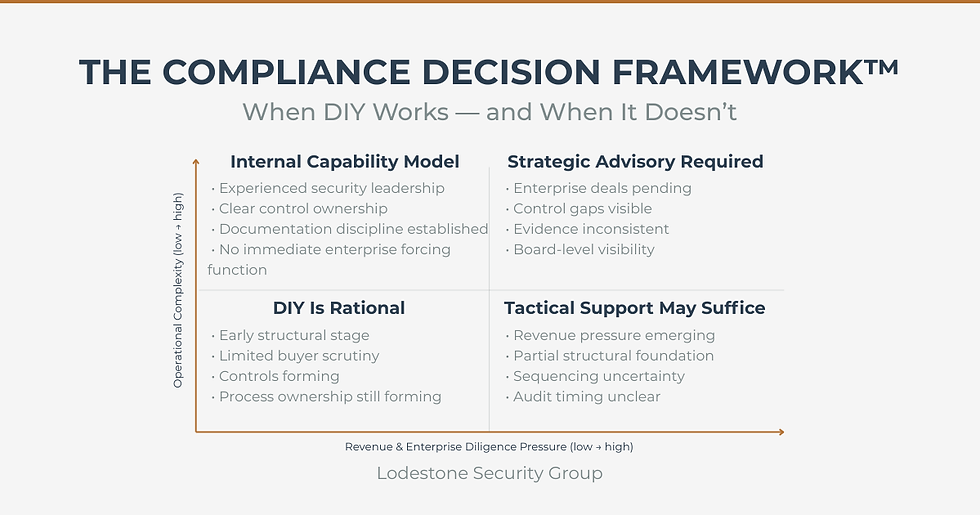
If you’re unsure which path aligns with your stage, start with the Compliance Decision Framework™. It evaluates revenue pressure, operational stability, risk surface, and ownership — the factors that determine sequencing.
Certification is not a milestone.
It is a signal.
And signals should be chosen deliberately.
Want more structural insights and trust architecture resources? Join the Lodestone mailing list for updates.
Comments